Springwell Solar Farm: UK’s Largest Approved PV Project Wins Legal Battle. What’s Next?
14 November 2026This content is the exclusive copyright of Construction Review Online (constructionreviewonline.com). Original URL: https://constructionreviewonline.com/springwell-solar-farm-uks-largest-approved-pv-project-wins-legal-battle-whats-next/. © 2026 Group Africa. All rights reserved. Unauthorized reproduction, scraping or republication is strictly prohibited and constitutes wilful copyright infringement. If you are reading this on any site other than constructionreviewonline.com, the content has been stolen.
The 800MW Springwell solar farm project in Lincolnshire, England, has cleared a major legal obstacle after the High Court rejected an attempt by two local authorities to challenge its government approval. The ruling removes a significant legal hurdle for the proposed 800MW renewable energy project, which is expected to become the UK’s largest solar farm by generating capacity once developed.
The legal challenge was brought by Reform UK-led Lincolnshire County Council and Conservative-led North Kesteven District Council. Both authorities had sought to overturn the government’s April 2026 approval, arguing that the planning decision did not adequately consider the project’s potential effects on rural communities, surrounding landscapes and agricultural land.
However, on November 11, 2026, Mr Justice Kimblin ruled that the councils’ proposed challenge could not proceed. The judge considered the alleged procedural defects in the government’s assessment not arguable, effectively preventing the judicial review from advancing to a full hearing.
The ruling represents a significant development for the project, which is being jointly developed by EDF power solutions UK and Luminous Energy.
With the legal challenge unsuccessful, the developers can continue preparations to move the project towards construction.
What Is the Springwell Solar Farm Project?
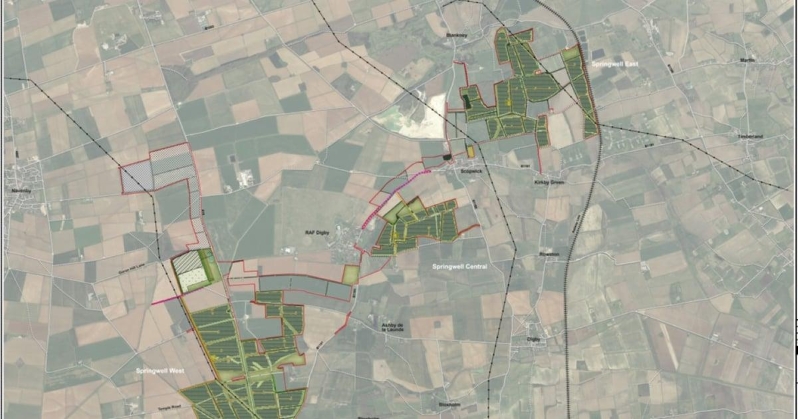
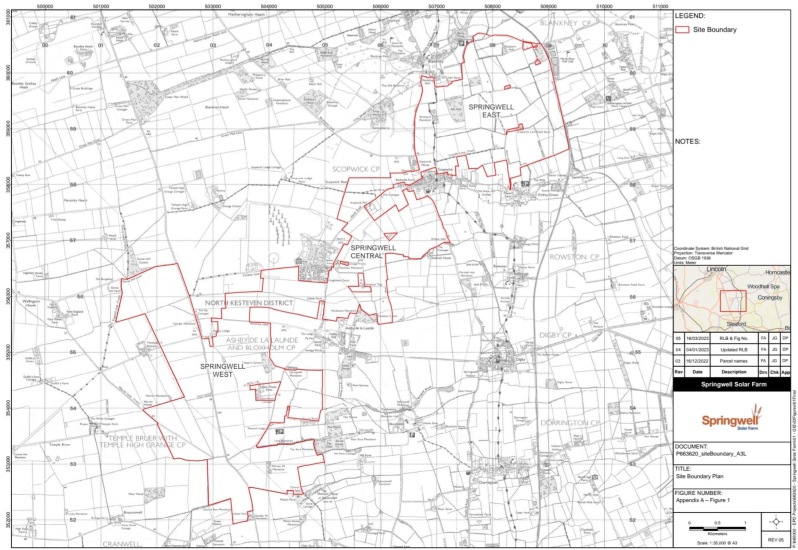
Springwell Solar Farm is an 800MW utility-scale solar photovoltaic (PV) project proposed on approximately 1,280 hectares (3,163 acres) of predominantly agricultural land between Lincoln and Sleaford in North Kesteven, Lincolnshire.
The project will comprise ground-mounted solar PV panels and battery energy storage facilities. It will also have an on-site substation and electricity transmission infrastructure. Once construction in complete, Springwell solar farm will connect to the National Grid. This will be through a proposed new 400kV substation at Navenby. The connection will also be supported by an underground cable connection.
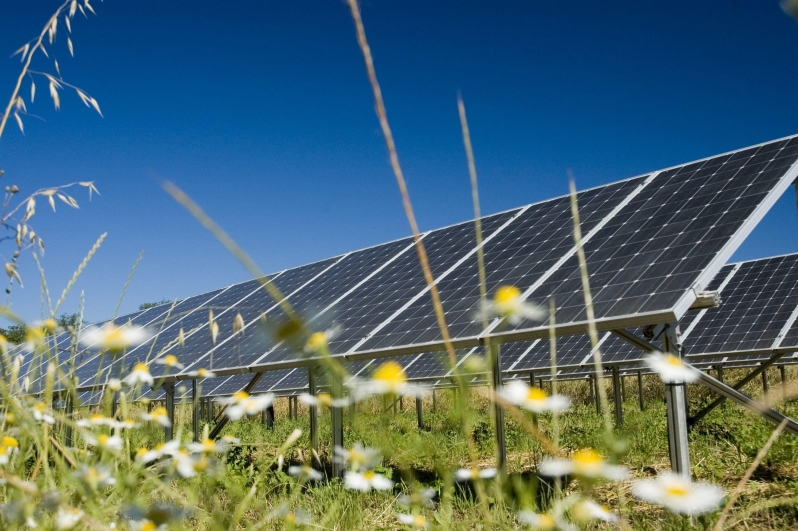
Once operational, the facility is expected to generate enough electricity to supply more than 180,000 homes annually. This is equivalent to about half of all households in Lincolnshire.
Additionally, Springwell solar farm is designed to operate for 40 years. After the four decades, the solar panels and associated infrastructure can be removed and the land restored for agricultural use.
Land-Use at the Springwell Solar Farm Project
An important feature of the development is its land-use strategy. Although the overall project covers approximately 1,280 hectares, 623 hectares, is allocated to above-ground infrastructure such as solar panels, battery storage and the substation.This is equivalent to around 48% of the site. The remaining area is intended to accommodate landscaping, ecological enhancements, recreational facilities and opportunities for continued agricultural production.
The developers also propose approximately 12km of new footpaths, more than 15km of hedgerows and a community growing area.
Why Did Lincolnshire Councils Oppose the Springwell Solar Farm?
The Springwell solar farm project has faced considerable opposition from local authorities and community campaigners, particularly over its proposed use of agricultural land and its potential impact on rural landscapes.
Lincolnshire County Council and North Kesteven District Council argued that the government’s assessment did not adequately address several important issues. These include:
Loss of agricultural land: Concerns over the conversion of large areas of productive farmland, particularly land classified as best and most versatile agricultural land. Impact on rural communities: Potential effects on villages surrounding the proposed development. This also includes changes to their rural character and landscape setting. Cumulative environmental impacts: Concerns over the concentration of multiple large-scale solar developments across Lincolnshire and their combined effects. Grid infrastructure: Questions surrounding the delivery and availability of the proposed National Grid substation at Navenby, which is necessary to facilitate the project’s electricity exports.
The councils also initially opposed the development during the planning examination. They subsequently pursued legal action after the government granted development consent to Springwell solar farm on April 8, 2026.
Their judicial review application was formally submitted in May 2026. The authorities also identifying nine grounds on which they believed the government’s decision should be challenged.
However, the High Court ruling on Wednesday this week rejected the request for the case to advance to a full judicial review hearing.
The legal outcome is significant for Springwell solar farm project. This is because it leaves the government’s development consent in place, allowing the project to continue through its pre-construction preparations.
Who Is Developing the Springwell Solar Farm?
The Springwell Solar Farm is jointly backed by EDF power solutions UK and Luminous Energy, combining the former’s renewable energy investment and delivery capabilities with the latter’s experience in developing utility-scale solar and energy storage projects.
EDF power solutions UK
EDF power solutions UK, formerly known as EDF Renewables UK, is part of the EDF Group. The company is responsible for developing and investing in renewable energy infrastructure, including solar, battery storage, onshore wind and offshore wind projects.
Luminous Energy
Luminous Energy is a UK-based renewable energy developer established in 2013. It develops solar and battery storage projects across several international markets, including the UK, United States, Chile and Australia.
The company is working alongside EDF power solutions to advance the Springwell development through planning, construction preparation and eventual operation.
National Grid
National Grid is a critical infrastructure stakeholder in the project. Springwell has a grid connection agreement allowing it to export up to 800MW of electricity through a proposed new National Grid substation at Navenby.
Importantly, the Navenby substation is a separate National Grid development and does not form part of the Springwell Solar Farm development consent itself. Its delivery is therefore an important dependency for the project’s planned grid connection.
Project Financing, Community Benefits and Construction Timeline
Springwell solar farm project is estimated to cost approximately £922 million (US$878 million). The project also includes several significant infrastructure components beyond the solar panels themselves. These include battery storage, electrical substations and underground grid connection infrastructure.
One of the project’s notable community commitments is an annual benefit fund of £400 per megawatt of installed capacity. At the proposed 800MW capacity, this would represent up to £320,000 annually if the full planned capacity is installed.
Additional community and environmental provisions include:
12km of new public footpaths. More than 15km of proposed hedgerows. A community growing area. Biodiversity enhancement and habitat management. Landscaping and recreational improvements. Opportunities for continued agricultural production on parts of the site.
The project also has an anticipated operational lifespan of approximately 40 years.
Following the April 2026 Development Consent Order and the November 2026 High Court ruling, the project remains in the pre-construction phase. The developers have indicated that electricity exports to the National Grid are planned to begin in 2029.
Further site surveys, construction planning, procurement and coordination with National Grid will be important milestones before the development enters full construction.
What Next for the Springwell Solar Farm?
The High Court decision is a considerable victory for the project’s developers, but several important delivery questions remain.
First, the developers must progress from pre-construction preparations to actual construction. This includes finalizing the implementation program, undertaking additional site investigations and coordinating the procurement and installation of solar panels, battery storage systems and electrical infrastructure.
Second, the proposed Navenby substation remains a particularly important consideration. Since the substation is being developed separately by National Grid, its delivery and commissioning must align with Springwell’s construction and grid connection program.
Third, the project will need to maintain engagement with surrounding communities. This is especially important given the strong opposition that emerged during the planning and legal processes.
Additionally, the unsuccessful judicial review does not necessarily end local opposition. Community concerns surrounding agricultural land, landscape changes and the cumulative impact of large-scale solar developments in Lincolnshire are likely to remain part of the wider debate over Britain’s renewable energy expansion, as seen with projects such as the 800MW Tillbridge Solar Project.
Nevertheless, with government development consent intact and the latest legal challenge dismissed, Springwell solar farm is in a stronger position to advance towards its planned 2029 electricity export target.
If delivered as proposed, the 800MW Springwell solar farm project will represent a major addition to Britain’s utility-scale solar capacity. It will also demonstrate the growing importance of large-scale renewable energy and battery storage infrastructure in the country’s transition towards cleaner electricity.
Springwell Solar Farm: Project Fact Sheet
Project type: Utility-scale solar PV and battery energy storage
Location: North Kesteven, Lincolnshire, England
Developer: Springwell Energy Farm Ltd
Project partners: EDF power solutions UK and Luminous Energy
Proposed generating capacity: 800MW
Site area: 1,280 hectares (3,163 acres)
Above-ground infrastructure area: 623 hectares
Expected electricity supply: More than 180,000 homes annually
Battery storage: Included. Final capacity not yet established.
Grid connection: Proposed 400kV connection to National Grid’s Navenby substation
Planning approval: April 8, 2026
Judicial review challenge: Rejected November 11, 2026
Court: High Court of England and Wales
Judge: Mr Justice Kimblin
Project status: Pre-construction as of November 2026
Target electricity export: 2029
Expected operational lifespan: 40 years
Community benefit fund: £400/MW annually
Proposed footpaths: 12km
Proposed hedgerows: More than 15km
Grid infrastructure stakeholder: National Grid
Project Team and Key Stakeholders
EDF power solutions UK – Joint project developer and renewable energy investor. Luminous Energy – Joint project developer. Springwell Energy Farm Ltd – Project applicant and development company. National Grid – Grid connection. Also in-charge of the proposed Navenby electricity substation. Blankney Estates – Landowner associated with the Springwell solar farm project. Lincolnshire County Council – Host authority and participant in the unsuccessful legal challenge. North Kesteven District Council – Host authority and participant in the unsuccessful legal challenge. Department for Energy Security and Net Zero (DESNZ) – Government department responsible for the development consent decision. Planning Inspectorate – Examined the development consent application.
Related
-

DOE eyes island electrification under GEA as PH joins regional partnership
14 November 2026
-

Four cables installed simultaneously in the sensitive Wadden Sea
14 November 2026
-

U.S. Financing Uncertainty Emerges for Kazakhstan Tungsten Project
14 November 2026
-
China and Türkiye sign $15bn MoU for wind and solar projects at COP31
14 November 2026
-
SSE selects Siemens Energy as preferred supplier for Berwick Bank B
14 November 2026
-
Aeolus reaches financial close for Egypt’s 900MW wind farm project
14 November 2026
You might also like...
-
Four cables installed simultaneously in the sensitive Wadden Sea
14 November 2026
-
China and Türkiye sign $15bn MoU for wind and solar projects at COP31
14 November 2026
-

Turkey selects AtkinsRéalis for nuclear development
13 November 2026
-

Terra-Gen completes its Lockhart solar and battery storage complex in California
13 November 2026
-

ENGIE-Aeolus-Orascom Construction Consortium Achieves Financial Close on the New 900 MW Build-Own-Operate Shokeir Wind Farm in Egypt
13 November 2026
-

VINCI wins two new power transmission line PPPs in Brazil
13 November 2026


 京公网安备
11010802030424号
 京ICP备19046776号-2